
Study in Cyprus (South) Mid-Range
Cheaper alternative: EU-side universities; English-taught · ≈ $19k/yr all-in
Ireland is where the world’s biggest tech and pharma companies put their European headquarters — Google, Meta, Apple, Microsoft, Pfizer, Johnson & Johnson — and where a master’s graduate can typically stay back two full years to work. Trinity College Dublin, UCD, UCC and peers punch far above the country’s size; the people are famously welcoming; and there’s no language barrier at all. Dublin rents bite — we’ll show you Cork, Galway and Limerick maths too. If your target is an English-speaking career launch inside the EU, Ireland is the answer hiding in plain sight.
The complete, honest case for Ireland — the graduate stay-back, the tech & pharma hiring engine, the Dublin cost warning, and the exact route from Pakistan — in one short narrated briefing.
The Ireland video briefing is in production
The narrated 4-minute briefing for Ireland lands in this slot very soon. Until then, get the exact same briefing — live, personal, and free — from a counsellor who will map it to your grades and budget.
Ireland hosts the EMEA headquarters of the world’s biggest technology and pharmaceutical firms — and they hire locally, in English, at European salaries. For computing, data, pharma, biotech, medtech and finance graduates, no country this size offers this density of multinational employers. Your degree plugs straight into that hiring machine.
Ireland’s Third Level Graduate Programme typically lets master’s graduates (NFQ Level 9) remain up to 24 months to seek and take up employment — bachelor’s (Level 8) graduates typically 12 months. From there, Critical Skills and General Employment Permits build toward long-term residence (Stamp 4). It’s one of Europe’s most graduate-friendly ladders.
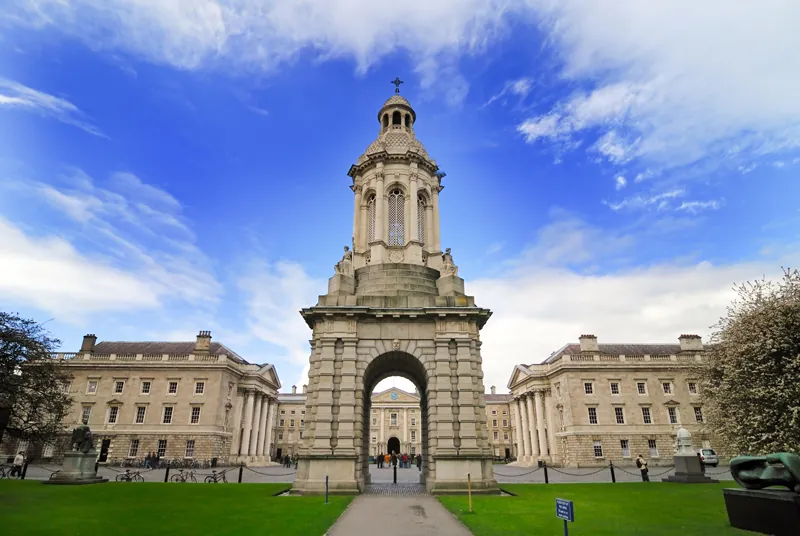
Trinity College Dublin (founded 1592), University College Dublin, University of Galway, UCC, University of Limerick, Maynooth and the technological universities — respected by employers and immigration officers alike, with particular strength in pharma, computing, business and health. Your CV carries the name worldwide.
No “English-taught island in a foreign-language sea”: lectures, landlords, employers, doctors and bus drivers all operate in English. For students (and parents) who want Europe without the language project, Ireland removes the single biggest friction of continental study.
Nine of the world’s top ten pharma companies operate in Ireland; the medtech cluster around Galway is world-scale. Chemistry, pharmaceutical science, biomedical engineering and regulatory-affairs graduates walk into a jobs market built for them — a field-specific advantage few destinations can copy.
Honest maths: Dublin rents rival London’s. But Cork, Galway, Limerick and Waterford host excellent institutions at markedly lower living costs, with the same stay-back rights and their own employer clusters. Our shortlists compare total cost city by city — most families are surprised how far the budget stretches outside the capital.
Computer Science & Data AnalyticsPharmaceutical & Biotech SciencesBusiness & FinanceBiomedical & Medtech EngineeringNursing & HealthDigital MarketingSupply Chain & LogisticsLawFood ScienceCybersecurity
| Item | Guide figure | What to know |
|---|---|---|
| Tuition (non-EU) | ≈ €10,000–25,000 / year | Business & computing mid-range; medicine and specialist programmes far higher |
| Living costs — Dublin | ≈ €1,300–1,900 / month | Rent is the battle; purpose-built student housing books out early |
| Living costs — Cork / Galway / Limerick | ≈ €950–1,300 / month | Same degree value, friendlier budgets — a core part of our Ireland strategy |
| Visa funds evidence | ≈ €10,000 for your first year (guide) | Irish immigration guidance figure for degree students — we confirm the current requirement for your case |
Comparing countries on cost? See how Australia compares — full cost guide or scan every option in the Premium: World Elite budget hub.
The flagship is the Government of Ireland International Education Scholarship: a full fee waiver plus a €10,000 stipend for one year, awarded to a small number of outstanding students — competitive, and worth a professionally built application. Beneath it, universities run international merit scholarships (commonly €1,000–€5,000, some percentage-based up to 50% at select institutions). We apply you to every award your grades qualify for, automatically.
Graduates use the Third Level Graduate Programme: typically 12 months after a Level 8 bachelor’s and up to 24 months after a Level 9 master’s, working full-time while you job-hunt or settle into a role. Employment then moves onto Critical Skills (fast-track, for shortage occupations) or General Employment Permits, with long-term residence (Stamp 4) reachable after qualifying years. In term time you may work 20 hrs/week (40 in holidays) — a real contribution outside Dublin rents.
We align your field with Ireland’s employer clusters (tech in Dublin, medtech in Galway, pharma nationwide) and set your city by total cost, not habit.
Direct applications with transcripts, references and SOPs tuned to Irish admissions — plus GOI-IES and every university merit award your profile earns.
Funds evidence to Irish immigration standard, insurance arranged, accommodation hunt started early — and your stay-back clock explained before you even land.
The Third Level Graduate Programme is a defined immigration permission for eligible graduates of Irish institutions — master’s graduates typically receive up to 24 months. It isn’t a job guarantee: you must still win the role. What it guarantees is time and work rights — the two things graduates elsewhere run out of. We verify your course’s NFQ level before you apply, because that level sets your stay-back length.
Irish guidance expects degree students to evidence access to around €10,000 for the first year of study (in addition to fees), from properly documented sources. The exact evidence rules are updated periodically — we build your file to the current standard and check every statement before filing.
If your budget is comfortable and your target employers cluster in Dublin, the capital earns its rent. Otherwise Cork, Galway and Limerick deliver the same national stay-back rights, strong universities and multinational employers at hundreds of euros less per month. Your free session includes a city-by-city cost comparison for your exact course.
Most Irish universities require an English test (IELTS typically 6.0–6.5, or accepted equivalents like PTE/Duolingo at many institutions). Some accept a Medium of Instruction letter for specific programmes — we verify per university rather than assume, so your application never dies on a technicality.
Ireland is consistently among Europe’s most welcoming countries for Pakistanis, with established communities and mosques in Dublin, Cork and Galway, and halal food widely available. Universities run strong international-student support — and our pre-departure briefing covers neighbourhoods, housing scams and first-month essentials honestly.
Still weighing it up? Browse the Europe – Beyond Schengen region hub or the Premium: World Elite budget hub to compare Ireland against its closest alternatives.
Four honest alternatives drawn from the Europe – Beyond Schengen region hub, the Premium budget tier and the premium step-up shelf — each with the reason it belongs on your shortlist.
Cheaper alternative: EU-side universities; English-taught · ≈ $19k/yr all-in

Cheaper alternative: MBBS in English; popular with Pakistani students · ≈ $10k/yr all-in
Same budget (Premium), different map: Largest choice; scholarships & STEM-OPT strategy · ≈ $45k/yr all-in
The aspirational step-up: Design, life sciences, green tech · ≈ $26k/yr all-in